
Most renters in New York and Pennsylvania carry one assumption into their lease: the landlord’s insurance covers everything. It does not. A landlord’s policy insures the building itself. It does not cover your furniture, your electronics, your clothing, or your financial exposure if someone gets hurt in your apartment. Those risks fall entirely on you unless you carry your own policy.
Renters insurance is one of the least expensive insurance products available. The national average runs under $170 per year according to the Insurance Information Institute. For that cost, a renter gets coverage for personal property, personal liability, and temporary housing expenses after a covered loss. But not all renters insurance is the same, and the decisions you make when you buy a policy determine how much you actually recover when something goes wrong.
This guide covers the core types of renters insurance coverage, the most consequential decision you will make (actual cash value versus replacement cost), the optional add-ons worth considering, what drives your premium, and how to choose a policy that fits where you live and what you own.
Key Takeaways
-
There are several types of renters’ insurance, including personal property coverage, liability coverage, and loss of use.
-
The biggest decision for renters is whether to choose actual cash value or replacement cost coverage.
-
Renters insurance is affordable and offers significant financial protection during theft, fire, water damage, or liability incidents.
-
Working with Patriotic Insurance Group helps you compare and customize coverage based on your belongings and budget.
What a Standard Renters Insurance Policy Covers
Every standard renters insurance policy is built from three core protections. Each one addresses a different category of financial risk.
Personal Property Coverage
Personal property coverage pays to repair or replace your belongings after a covered loss. Standard covered events include fire, smoke damage, theft, vandalism, and certain water damage from internal sources such as a burst pipe or an overflowing appliance. It does not cover floods or earthquakes unless you add separate coverage for those perils.
The items this coverage protects include furniture, electronics, clothing, kitchenware, appliances you own, bicycles, and most other personal possessions you keep in the unit. Some high-value items, including jewelry, instruments, and collectibles, have sub-limits under standard policies. If you own items in those categories, you may need to add them separately.
Personal property coverage often extends beyond the unit itself. Most policies cover your belongings while they are in your car, in a storage unit, or with you while you travel. The policy limit and deductible still apply.
Personal Liability Coverage
Liability coverage pays for bodily injury or property damage that you cause to others. It covers legal defense costs and settlements up to your policy limit. Common situations that trigger liability claims include a guest falling and being injured in your apartment, your pet biting a neighbor, or water from your unit leaking into the unit below and damaging the neighbor’s property.
Most standard renters’ policies provide $100,000 in liability coverage as a base. Many renters, particularly those in larger urban areas or those with pets, carry $300,000 or more. The cost difference between $100,000 and $300,000 in liability coverage is typically small, often $10 to $20 per year, because liability claims in renters insurance are relatively infrequent.
Loss of Use Coverage
Loss of use coverage, also called additional living expenses, pays for temporary housing and related costs if your rental unit becomes uninhabitable because of a covered loss. If a fire makes your apartment unlivable for three months, this coverage pays for your hotel or short-term rental during that period, along with costs like meals and laundry that exceed your normal expenses.
The coverage limit for loss of use is typically set as a percentage of your personal property limit, often between 20% and 30%. In New York City, where hotel rates are high, a standard loss of use limit can be exhausted quickly. Renters in high-cost areas should confirm this limit is adequate when buying a policy.
Actual Cash Value vs. Replacement Cost: The Decision That Changes Your Payout
This is the most consequential choice in renters insurance. Both policy types cover the same perils. The difference is in how much you receive after a loss.
Actual Cash Value (ACV)
An actual cash value policy pays you the depreciated value of a lost or damaged item at the time of the claim. Depreciation reflects the age and wear of the item. A television you bought five years ago for $900 may have a depreciated value of $150 today. If that TV is stolen and you carry ACV coverage, you receive $150, less your deductible. You pay the remaining cost of replacing the TV out of pocket.
ACV policies carry lower premiums. The trade-off is that the payout after a significant loss often covers only a fraction of what it costs to replace what you lost. Renters who choose ACV to save money sometimes find that saving is outweighed by a large out-of-pocket gap after a real claim.
Replacement Cost Coverage (RC)
A replacement cost policy pays you the amount it costs to buy a new equivalent item today, without a depreciation deduction. The same stolen television is reimbursed at the current retail price of a comparable replacement, less your deductible. A laptop, a sofa, a winter coat, a camera — each item is valued at what it would cost to replace it new.
RC premiums are higher than ACV premiums. The increase is typically 10% to 20% of the total premium. For a renter paying $18 per month for an ACV policy, the RC version might cost $21 to $22 per month. Most renters who carry RC coverage and file a significant claim consider the premium difference well worth paying.

Optional Coverage Types Worth Considering
Standard renters insurance does not cover every situation. Renters who own specific high-value items, live in certain buildings or geographies, or carry particular risk profiles often need one or more of the following add-ons.
Scheduled Personal Property
Standard personal property coverage applies sub-limits to certain item categories. Jewelry, engagement rings, musical instruments, fine art, cameras, and collectibles commonly have per-item or per-category caps under a base policy. If you own a violin worth $4,000, your base policy may pay only $1,500 for its loss.
Scheduling an item means listing it separately on the policy with its appraised value. A scheduled item is covered for that full value, typically without a deductible, and is often covered for a broader set of perils including accidental loss or breakage. Scheduling costs more but provides substantially better protection for items that are genuinely difficult to replace.
Water Backup and Sump Pump Failure Coverage
Standard renters insurance covers water damage from internal sources that are sudden and accidental, such as a burst pipe. It does not cover water that backs up through a drain or sewer line, or damage caused by a failed sump pump. Both are common sources of property damage in older buildings and in areas with combined sewer systems.
Water backup coverage is an endorsement, meaning it adds to an existing policy rather than being a standalone product. In New York City, where aging sewer infrastructure produces periodic backup events, and in low-lying Pennsylvania counties prone to heavy rain infiltration, this coverage is frequently underutilized and worth evaluating.
Identity Theft Coverage
Identity theft coverage helps pay for the costs of restoring your financial identity after a theft event. Covered expenses typically include legal fees, lost wages during recovery, postage and notarization costs, and fees charged by identity restoration services. It does not reimburse stolen money directly. That is typically handled through your bank’s fraud protections or a separate financial product.
The risk is real: the Federal Trade Commission receives millions of identity theft reports annually, and renters, who tend to share building common areas, mailboxes, and package delivery systems, face specific exposure to mail theft and in-person credential theft.
Pet Liability Coverage
Standard liability coverage includes pet-related incidents in many policies, but certain dog breeds are excluded by name from liability coverage under some carriers’ underwriting guidelines. Breeds commonly excluded include Pit Bull Terriers, Rottweilers, German Shepherds, and Doberman Pinschers, among others. If you own a breed that falls under an exclusion, liability for a bite incident may not be covered under your base policy.
Pet liability coverage, either as an endorsement or through a specialty carrier, provides explicit coverage for your animal regardless of breed. In New York and Pennsylvania, where landlords and building managers increasingly require proof of pet liability coverage before approving tenants, this endorsement is both financially important and sometimes practically necessary.
Earthquake and Flood Coverage
Standard renters insurance excludes both earthquake and flood damage. These are separate perils requiring separate coverage. Flood insurance for renters is available through the National Flood Insurance Program (NFIP) and through private flood insurers. It covers personal property damaged by flooding but does not cover the building structure, which is the landlord’s responsibility.
Renters in Federal Emergency Management Agency (FEMA) designated flood zones, particularly in coastal New York and along Pennsylvania river corridors, face material flood risk. Earthquake risk is lower in the Northeast but is not zero. Renters in areas with documented seismic activity should evaluate whether earthquake coverage is warranted.
What Determines the Cost of Renters Insurance
Renters insurance is inexpensive by insurance standards. The Insurance Information Institute reports a national average premium of approximately $170 per year, under $15 per month. In New York and Pennsylvania, premiums vary based on a set of specific factors.
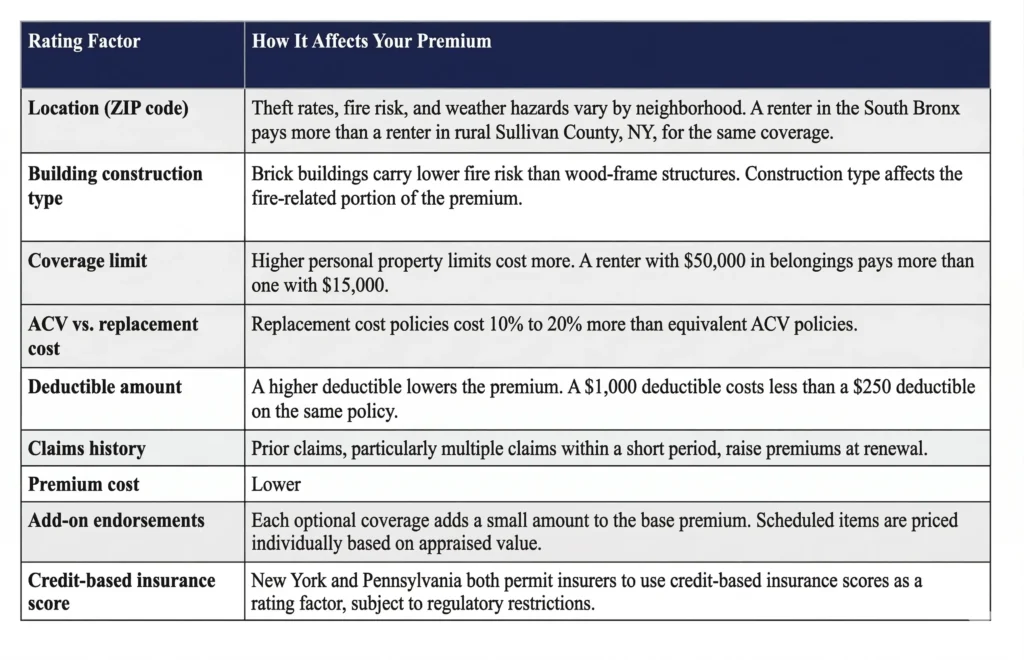
The combination of all these factors means two renters in the same building can pay different premiums. The renter who owns more, carries replacement cost coverage, and chose a low deductible pays more than the renter with minimal possessions, ACV coverage, and a high deductible. Neither is wrong. They reflect different levels of protection.
Step 1: Build a Home Inventory
Walk through your unit and list everything of value. Furniture, electronics, clothing, kitchenware, tools, hobby equipment, sporting goods, jewelry, and anything else you own that you would need to replace after a total loss. Estimate the replacement cost of each item. Photograph or video the contents of each room and store the record somewhere outside the unit, either in cloud storage or with a trusted contact.
This inventory serves two purposes. It tells you what coverage limit to buy, and it provides documentation if you ever file a claim. Insurers require itemized proof of loss for significant claims. Renters who lack documentation often receive lower settlements than those who can demonstrate what they owned.
Step 2: Choose Between ACV and Replacement Cost
If replacing your belongings out of pocket after a total loss would be financially difficult, choose replacement cost. The premium difference is modest. The financial difference after a serious claim is not. ACV coverage makes practical sense only for renters whose possessions are relatively new (and therefore carry minimal depreciation) or whose total belongings are low enough in value that the depreciation gap is acceptable.
Step 3: Set Your Liability Limit
New York and Pennsylvania renters face real liability exposure. A $100,000 limit is the standard starting point, but many renters benefit from carrying $300,000. If you own a dog, host frequent guests, or live in a building where common-area incidents could create liability questions, $300,000 is the more defensible choice. The annual cost difference between $100,000 and $300,000 in renters liability coverage is typically $10 to $25.
Step 4: Evaluate Optional Add-Ons for Your Specific Situation
Work through the optional coverages against your actual circumstances. If you own a musical instrument or jewelry of significant value, scheduled personal property coverage is worth pricing. If you live in a building with a history of sewer backups or if your unit is below grade, water backup coverage is worth adding. If your landlord requires pet liability coverage for approval, you need it. If your building is in a FEMA flood zone, flood coverage for personal property is not optional in any practical sense.
Step 5: Compare Quotes from Multiple Carriers
Premium pricing for renters insurance varies meaningfully between carriers for the same coverage. Two insurers rating the same renter in the same ZIP code with identical limits can quote premiums that differ by $60 to $120 per year. An independent agency accesses multiple carriers simultaneously, which means you see a range of prices and can identify where your profile is rated most favorably without spending hours requesting individual quotes.
Bundling your renters policy with auto insurance typically reduces the premium on both policies by 5% to 15%. If you already carry auto insurance, ask whether the same carrier offers renters coverage and what the bundled rate looks like.
Frequently Asked Questions
-
Is renters’ insurance required?
It depends. Some landlords require renters’ insurance in lease agreements.
-
Does renters’ insurance cover water damage?
It covers certain sudden and accidental water events, but not floods or sewer backups unless you add extra protection.
-
Does renters’ insurance cover roommates?
Typically no. Each person should have their own policy.
-
Is renters insurance expensive?
No. Most renters pay less than fifteen dollars per month for essential coverage.
-
Does renters’ insurance cover theft outside the home?
Yes. Personal property is usually covered anywhere in the world.
Ready to Find the Right Renters Insurance Policy?
Renters insurance costs less per month than most streaming subscriptions. What it covers — your belongings, your liability exposure, and your housing costs after a loss — can run into the tens of thousands of dollars. The gap between what a policy costs and what it can pay out is one of the most favorable in any insurance category.
The decisions you make when buying a policy matter, though. Actual cash value versus replacement cost, your liability limit, and which endorsements you carry — these choices determine what you actually recover when something goes wrong. Getting them right is worth a conversation with someone who knows the New York and Pennsylvania markets.
Contact Patriotic Insurance Group to compare renters insurance options across multiple carriers. We work with renters across New York and Pennsylvania and can match coverage to your specific situation, building type, and budget.