
New York drivers pay more for auto insurance than most people in the country. That is not a rumor or a feeling. The numbers bear it out. The average cost of auto insurance in NY runs several hundred dollars above the national average each year, and in New York City and on Long Island, the gap is wider still.
The reasons are specific and well-documented. Population density, a mandatory no-fault insurance structure, above-average vehicle theft rates, and a litigation environment that pushes claim costs higher all contribute to what you pay. None of those factors is going away. But understanding them gives drivers a clearer picture of where their premium comes from and which parts of it they can actually influence.
This guide covers the full picture: statewide averages broken down by coverage type, how NY compares to neighboring states, what your personal profile does to your rate, the state minimum coverage requirements, and eight proven ways to reduce what you pay. Patriotic Insurance Group has advised New York drivers on auto insurance for years, and the guidance here reflects what we see working in the market today.
Key Takeaways
-
The average cost of auto insurance in NY is higher than the national average due to population density, accident frequency, and insurance requirements.
-
Rates vary widely across New York, with Long Island and NYC being the most expensive regions.
-
Comparing providers and adjusting coverage can help drivers reduce costs without losing essential protection.
-
Working with an independent agency like Patriotic Insurance Group helps drivers navigate pricing and find competitive options.
The Average Cost of Auto Insurance in NY
According to recent data from the Insurance Information Institute, the average cost of auto insurance in NY is approximately $2,400 to $2,700 per year, depending on coverage level and location. Nationally, the average sits closer to $1,700 per year, putting New York several hundred dollars above the national average.
This makes New York one of the more expensive states for car insurance, joining states like Florida, Louisiana, and Michigan, which have historically higher claims costs and insurance regulations.
How NY Rates Compare to Neighboring States
New York consistently sits among the five most expensive states for auto insurance. The table below places NY alongside its neighbors and identifies the primary factor driving costs in each state.
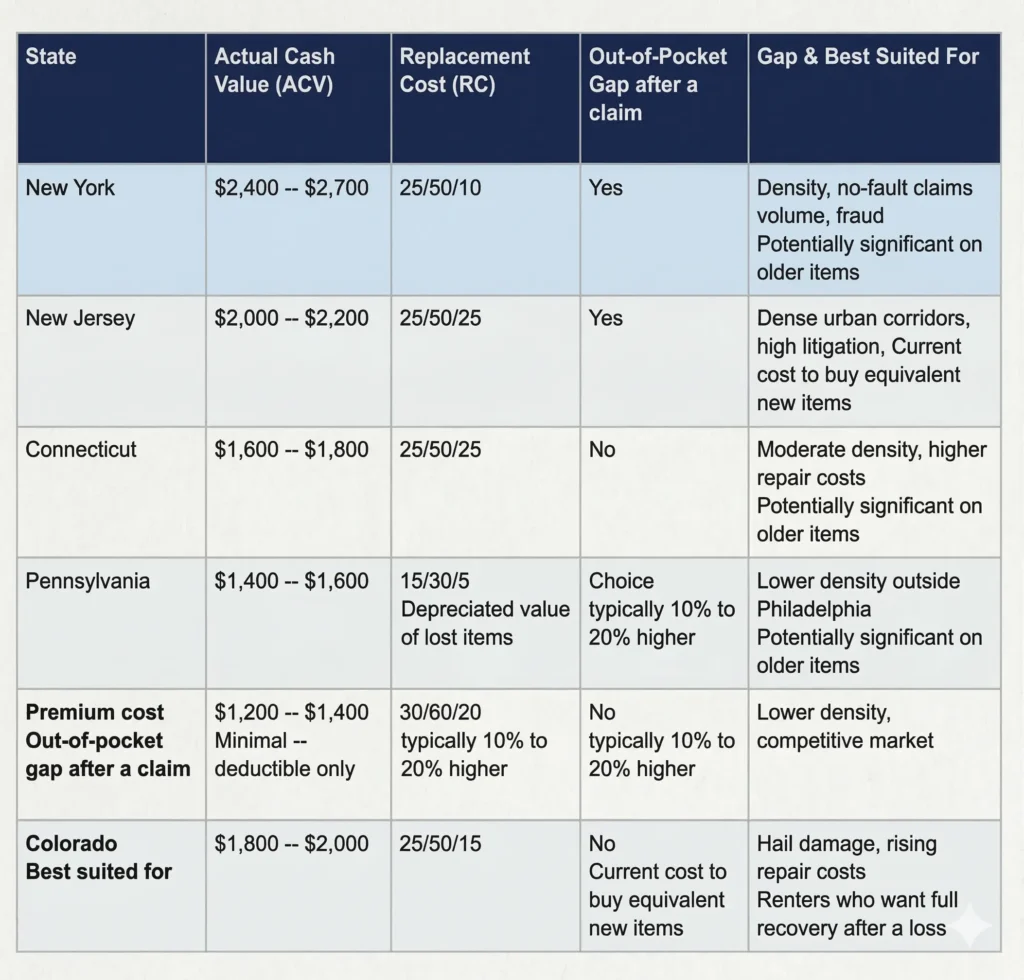
New Jersey is the closest comparison to New York. Both states use a no-fault system, both have dense urban corridors, and both carry a significant litigation burden. Pennsylvania is cheaper partly because its no-fault system is optional — drivers can choose a tort-based policy that carries lower base costs. Virginia sits at the lower end because it has no no-fault requirement and less concentrated urban density than any of the northeast corridor states.
Why Is Auto Insurance So Expensive in New York?
Seven distinct factors explain why NY auto insurance rates sit where they do. Some apply to the whole state. Others are concentrated in specific regions.
Population Density and Accident Frequency
New York City has more registered vehicles per square mile than any other city in the United States. More vehicles in less space means more collisions, more claims, and more money paid out by insurers. The state as a whole ranks in the top five nationally for vehicle miles traveled in urban areas, and urban VMT (vehicle miles traveled) correlates directly with at-fault collision rates. Insurers price that risk into the premium.
State Minimum Coverage Requirements
New York law requires drivers to carry bodily injury liability of at least $25,000 per person and $50,000 per accident, property damage liability of $10,000, personal injury protection (PIP), and supplementary uninsured/underinsured motorist (SUM) coverage. Most states require less. A higher mandatory floor means a higher base premium even before insurers add anything for your individual risk profile.
No-Fault Insurance and How It Affects Your Premium
New York is a no-fault state. Under this system, your own insurer pays your medical bills after an accident regardless of who caused it. You file with your own carrier through personal injury protection (PIP). You do not sue the other driver for medical expenses unless your injuries meet a legal threshold of “serious injury” as defined under New York law.
This system increases claim volume substantially. Instead of two drivers filing against one insurer (the at-fault driver’s), both drivers file against their own insurer. Insurers in New York process far more medical claims per accident than their counterparts in tort states. That elevated volume is built into every policy premium in the state.
No-fault fraud compounds the problem. Staged accidents and inflated medical billing under PIP have cost New York insurers hundreds of millions of dollars annually according to the New York State Department of Financial Services. Those costs are distributed across all policyholders through higher premiums.
Vehicle Theft Rates and Repair Costs
The National Insurance Crime Bureau (NICB) consistently ranks New York among the top ten states for vehicle theft by volume. New York City, in particular, records theft rates that run well above the national per-capita average. Comprehensive coverage covers theft, and insurers factor local theft rates into comprehensive premiums by ZIP code. Drivers in high-theft ZIP codes pay more, even if their car has never been stolen.
Labor rates at body shops in the New York metro area are among the highest in the country. A repair that costs $3,200 in Columbus, Ohio may cost $5,500 in Queens. Collision and comprehensive claim payouts reflect those labor rates directly.
Weather and Climate Risk
Upstate New York carries sustained winter weather risk. Lake-effect snowstorms in the Buffalo and Rochester corridors produce road conditions that cause weather-related accidents every season. Flooding is a separate risk in downstate areas. Significant storms in recent years have produced widespread flood damage to parked and moving vehicles across Nassau, Suffolk, and several New York City boroughs. Both hazards generate comprehensive and collision claims that insurers price into premiums across the affected regions.
Legal Environment and Insurance Fraud
New York has a dense concentration of plaintiff-side personal injury attorneys and a legal environment where large bodily injury settlements are common, particularly in New York City. Insurers in this market carry higher reserves against potential litigation costs than they would in lower-litigation states. Those reserves ultimately come from policyholders. The New York State Department of Financial Services has documented staged accident rings operating across the five boroughs and parts of Long Island, specifically targeting the PIP system for fraudulent billing. The financial impact of that fraud runs to hundreds of millions of dollars per year across the market.
Vehicle Density and Urban Repair Economics
In New York City, parking density means vehicles are in close proximity to other vehicles for the majority of their time. Minor collisions in parking structures, parallel parking scrapes, and low-speed intersection contacts generate a large volume of small claims. Each claim, no matter how minor, triggers administrative costs and affects loss ratios. High loss ratios drive rates up across the board for drivers in the same rating territory.
Auto Insurance Costs by Region in New York
Where you live in New York matters as much as what you drive or how long you have been licensed. Insurers rate policies by ZIP code, and the premium difference between a driver in Buffalo and the same driver with the same car in Brooklyn can exceed $2,000 per year.

The spread from rural upstate to New York City is not subtle. A 45-year-old driver with a clean record and a 2021 Honda Accord might pay $950 per year in the Adirondack region and $3,800 for the exact same policy in the Bronx. Insurers are rating two entirely different risk environments.
How Your Personal Profile Affects Your NY Auto Insurance Rate
Your premium is not just your ZIP code. Insurers combine location with a set of individual rating factors to arrive at your specific price. Some of these factors you can influence. Others are fixed.
Driver Age and Experience
Drivers under 25 pay the highest premiums in any state, and New York is no exception. Teen drivers carry the highest actuarial risk in the market. Rates typically decline from ages 25 through 65, after which they may begin to rise again slightly. Adding a teen driver to a New York family policy can increase the total premium by 80% to 120%, depending on the carrier and the teen’s driving record.
Driving Record
New York uses a point system administered by the DMV. Moving violations add points to a license, and insurers use those points as a rate factor. A single speeding ticket can raise a premium by 15% to 25% for three years. An at-fault accident surcharge typically lasts three to five years depending on the carrier. A DUI or DWI conviction is the most severe rate event: expect surcharges of 50% to 100% or more, lasting up to six years, plus the possibility of non-renewal.
Vehicle Make, Model, and Year
Insurers rate vehicles on repair cost, safety performance, and theft frequency. A 2023 Dodge Charger costs more to insure than a 2023 Toyota Camry not just because it costs more to repair, but because Chargers are among the most stolen vehicles in the country. Electric vehicles carry higher comprehensive and collision rates in most markets because battery replacement and specialized labor are expensive. A vehicle with a five-star NHTSA safety rating may qualify for a discount on liability coverage because it statistically produces fewer serious injury claims.
Credit History
New York allows insurers to use credit-based insurance scores as a rating factor, with regulatory restrictions on how heavily it can be weighted. An insurance score is not the same as a credit score. It is a model built specifically around the statistical correlation between credit behavior and insurance claim frequency. Drivers with poor credit-based insurance scores pay more in New York, sometimes significantly more, even with identical driving records.
Annual Mileage
Drivers who put fewer than 7,500 miles per year on a vehicle pose less statistical risk than high-mileage commuters. Most insurers offer low-mileage discounts for drivers who qualify. Usage-based insurance programs extend this further: carriers including Progressive, Allstate, and Nationwide offer telematics programs in New York that track actual driving behavior and reward safe, low-mileage drivers with meaningful discounts. For NYC residents who rarely drive, these programs can cut premiums by 20% to 40%.
Coverage Continuity
A gap in coverage history signals elevated risk to insurers. In New York, a lapse in coverage also has a legal consequence: the DMV receives notification of any policy cancellation, and drivers who cannot demonstrate active coverage face registration suspension. Re-entering the market after a lapse typically means paying a surcharge of 10% to 20% for one to two years. Maintaining uninterrupted coverage is one of the cheapest long-term rate strategies available.
NY Coverage Requirements: What the Law Requires You to Carry
New York law specifies minimum coverage requirements for every registered vehicle. These are the floors, not the recommended amounts.

Comprehensive and collision coverage are not required by the state, but any lender or leasing company will require them for a financed or leased vehicle. Without both, the lender’s collateral is unprotected.
The liability minimums in New York are higher than in most states, but many insurance professionals advise carrying limits well above the minimums. A $50,000 bodily injury per-accident limit can be exhausted quickly in a serious multi-person accident, and anything above that limit becomes your personal financial liability.
High-Risk Drivers in New York: What You Need to Know About Non-Standard Coverage
New York does not use SR-22 filings. This surprises many drivers who have heard the term in connection with DUI convictions or serious violations in other states. An SR-22 is a certificate that an insurer files with a state DMV to verify that a high-risk driver carries the required minimum insurance. New York does not require this mechanism.
Instead, New York handles high-risk drivers through the New York Automobile Insurance Plan (NYAIP). The NYAIP is an assigned-risk pool. Drivers who cannot obtain coverage from a voluntary market insurer because of their record can apply through the NYAIP and will be assigned to a participating insurer. Coverage through the NYAIP is available but it costs significantly more than voluntary market coverage. NYAIP premiums can run 50% to 100% higher than comparable voluntary market policies.
Drivers assigned to the NYAIP should treat it as a temporary solution. A consistent record of safe driving and on-time premium payments over two to three years typically allows a driver to return to the voluntary market and access standard pricing again.
How to Lower Your Auto Insurance Premium in New York
Most drivers overpay, not because insurers are charging arbitrarily but because they have not optimized their policy or shopped their coverage recently. These eight approaches are specific to the New York market and are in use right now.
1. Compare Quotes Across Multiple Carriers
Rate variation between insurers for identical driver profiles in New York can exceed $800 per year. Two carriers using the same data can produce quotes that differ by 30% or more because each company weights rating factors differently. An independent insurance agent accesses multiple carriers simultaneously and can identify where your specific profile is priced most favorably. Going direct to a single carrier means accepting that carrier’s interpretation of your risk, with no way to know whether it is competitive.
2. Complete the NY Point and Insurance Reduction Program (PIRP)
New York law requires insurers to provide a 10% discount on liability and collision premiums for three years to any driver who completes an approved defensive driving course under the Point and Insurance Reduction Program. The course runs approximately six hours and is available online. The discount is mandatory — insurers cannot opt out of it. For a driver paying $2,500 per year, a 10% reduction saves $250 annually, or $750 over the three-year discount period. The course costs roughly $25 to $35.
3. Adjust Your Deductible
Raising your collision deductible from $500 to $1,000 typically reduces collision premiums by 10% to 15%. Raising it to $2,000 can reduce it by 20% to 25%. The trade-off is that you cover more out of pocket after a collision before insurance takes over. This strategy works best for drivers with a clean history and sufficient savings to absorb the higher deductible if needed. It makes less sense for drivers in dense urban areas who experience minor collisions regularly.
4. Bundle Your Auto Policy with Home or Renters Insurance
Most major insurers offer multi-policy discounts ranging from 5% to 25% when you combine auto with a home or renters policy. For New York City apartment dwellers, renters’ insurance is the relevant product. A renters policy in New York typically costs $15 to $25 per month, and the bundling discount it generates on the auto policy can more than offset that cost. The discount also often applies to the renters’ policy itself.
5. Enroll in a Telematics Program
Usage-based insurance programs monitor actual driving behavior through a smartphone app or a plug-in device. Carriers evaluate acceleration, braking, speed, and time of day. Drivers who score well receive discounts that can reach 20% to 40%. For low-mileage New York City drivers who take public transit for most trips and only drive occasionally, this is one of the most effective rate reduction tools available. Carriers offering these programs in New York include Progressive (Snapshot), Allstate (Drivewise), and Nationwide (SmartRide), among others.
6. Add Anti-Theft Devices
New York law entitles drivers to a premium discount for vehicles equipped with approved anti-theft devices. Eligible equipment includes factory-installed or aftermarket alarm systems, engine immobilizers, and VIN etching on windows. The discount varies by carrier but commonly ranges from 2% to 10% on comprehensive coverage. In high-theft ZIP codes across New York City and Long Island, this discount has a more significant impact because the base comprehensive rate in those territories is higher.
7. Maintain Uninterrupted Coverage
Insurers treat a lapse in coverage as a risk indicator. Beyond the pricing penalty, a lapse in New York triggers a DMV notification and can result in registration suspension. Drivers who let a policy cancel and then re-enter the market typically pay a re-entry surcharge for one to two years. If cost is a concern, reduce coverage before canceling. Drop comprehensive and collision on an older vehicle, raise deductibles, or ask about payment plan options. A reduced policy is better than no policy.
8. Review Your Policy Every Year
A vehicle depreciates. Your circumstances change. A full-coverage policy on a vehicle worth $8,000 may cost more in annual premiums than the vehicle is worth recovering in a total-loss scenario. Removing comprehensive and collision coverage from a low-value vehicle can reduce your annual premium substantially. A licensed agent at Patriotic Insurance Group can run this analysis for your current vehicle and coverage and identify whether your coverage structure still matches your actual risk and financial situation.
Frequently Asked Questions
Is New York really one of the most expensive states for auto insurance?
Yes. Due to population density, claims volume, and state requirements, New York typically ranks among the most expensive states.
Can moving within NY lower my auto insurance cost?
Yes. Rates in rural Upstate areas are much lower than those in NYC or Long Island.
Why do younger drivers pay more?
Drivers under 25 face higher premiums due to higher accident rates and fewer years of driving experience.
Is full coverage required in New York?
No. Only liability is mandatory, but lenders often require full coverage for financed or leased vehicles.
Does credit score impact auto insurance rates?
Yes. In many states, including New York, insurers may consider credit history as part of the rating.
Get the Right NY Auto Insurance Rate for Your Situation
New York drivers face a more complex insurance market than drivers in most states. The combination of no-fault requirements, regional rate variation, and the range of discounts available means that two drivers with nearly identical profiles can pay very different amounts depending on which carrier they are with and how their policy is structured.
Patriotic Insurance Group works with multiple carriers in the New York market. That means we can compare actual quotes for your specific profile rather than pointing you toward a single company’s pricing. If you have not reviewed your policy in the past year, there is a reasonable chance your coverage structure or your rate no longer reflects your situation accurately.
Contact Patriotic Insurance Group today to get a quote, review your current coverage, or ask any questions about how your premium is calculated. We advise New York drivers across every region of the state.